General Description
Earn your Certified Cybersecurity Technician credential in just 5 days with mutqen Open Education Platform — enroll now!
The Certified Cybersecurity Technician certification gives you a clear foundation in digital protection concepts, network security, vulnerability analysis, and incident response. If you are looking for a structured training program that helps you enter the field without confusion, this program puts you on the right path in a practical and direct way.
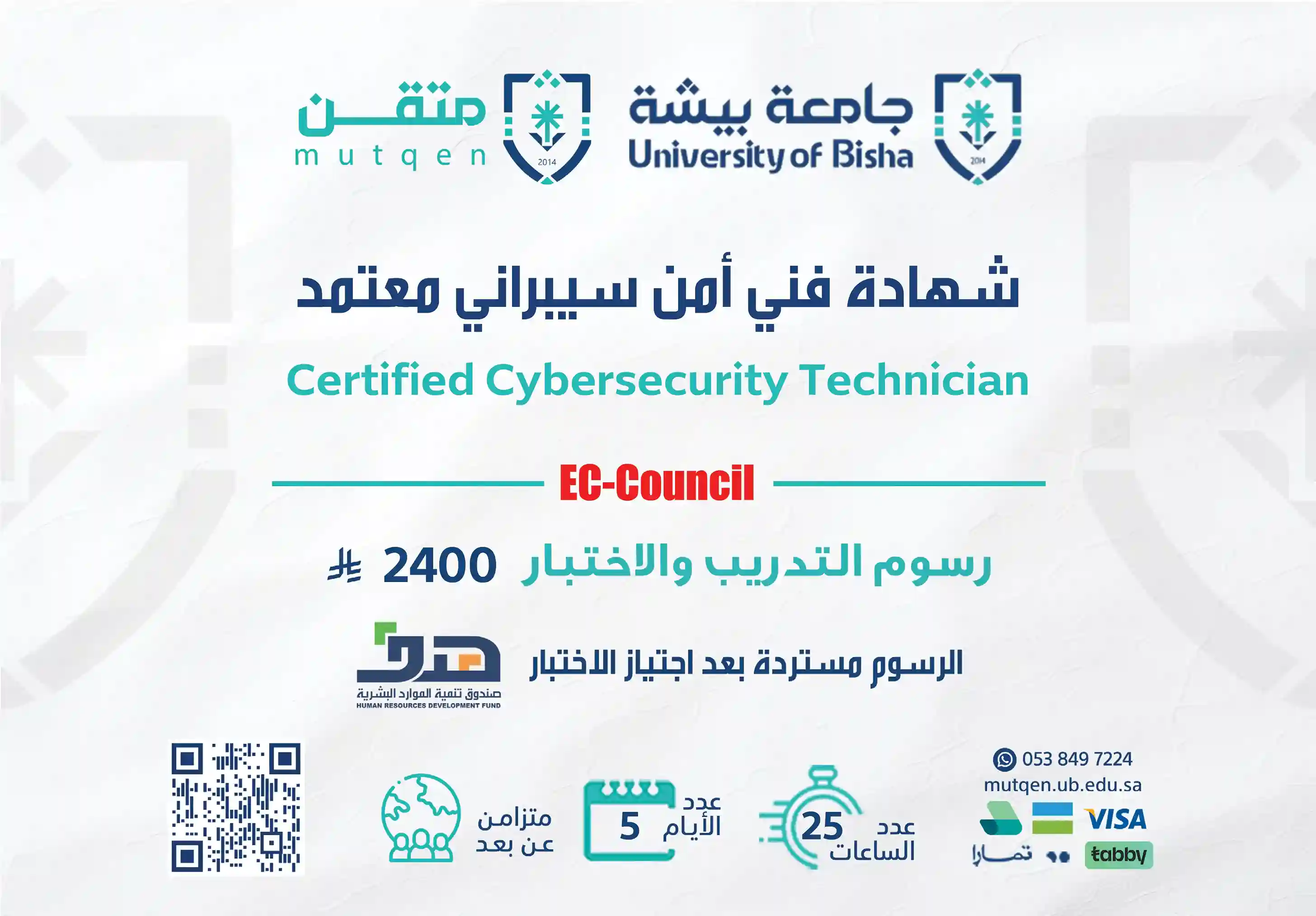
Through mutqen Distance Learning Platform, you can study the Certified Cybersecurity Technician program in just 5 days with 25 training hours, helping you understand modern threats, secure systems, and become familiar with security scanning and analysis tools in a way that suits beginners and those interested in technology. That is why the Certified Cybersecurity Technician certification has become a suitable choice for anyone who wants to build a strong professional start in Saudi Arabia, especially with the continuous expansion of digital transformation and the increasing focus on cybersecurity readiness in organizations.
The Goals
Objectives of the Certified Cybersecurity Technician Certification
The Certified Cybersecurity Technician certification aims to achieve a number of core objectives, including:
- Understanding basic cybersecurity concepts and modern threats
- Learning about network and technical infrastructure components and how to secure them
- Using vulnerability scanning and weakness analysis tools (Vulnerability Assessment)
- Applying the basics of Windows & Linux Security
- Understanding cyber threats and common attack types
- Handling cyber incidents (Incident Response)
- Securing accounts, passwords, email, and devices
- Using practical cybersecurity tools provided by EC-Council
These objectives show that the Certified Cybersecurity Technician certification does not only provide general information, but gives the trainee a real foundation that can later be built upon in more specialized cybersecurity paths in Saudi Arabia.
Target Auidence
Target Audience for the Certified Cybersecurity Technician Certification
The Certified Cybersecurity Technician certification is suitable for several groups, most notably:
- IT Support technicians
- Employees in IT departments
- Beginners in cybersecurity
- Students and graduates interested in the field
- Technical operations staff in organizations
The Features
Benefits of the Certified Cybersecurity Technician Certification
Obtaining the Certified Cybersecurity Technician certification gives you a number of important benefits, including:
- A certification accredited by EC-Council
- Helps you understand core cybersecurity concepts and modern threats
- Supports understanding network and technical infrastructure components and how to secure them
- Enhances the ability to use vulnerability scanning and weakness analysis tools
- Develops understanding of Windows & Linux Security fundamentals
- Raises awareness of how to secure accounts, passwords, email, and devices
- Gives the trainee a practical understanding of cyber incident response
- Represents a suitable starting point for anyone who wants to build a strong foundation in the field within the Kingdom
Topics
Topics Covered in the Certified Cybersecurity Technician Certification
The Certified Cybersecurity Technician certification focuses on a number of core modules that give the trainee a practical and organized understanding of the nature of work in cybersecurity.
Module 1: Introduction to Cybersecurity
In this module, the trainee learns about the concept of cybersecurity and its different fields, along with understanding modern threats and attacks targeting systems and data. The module also explains the difference between ethical hacking and malicious hacking, and provides an important foundation in data security and privacy protection. This makes the module the natural starting point for anyone studying the Certified Cybersecurity Technician certification.
Module 2: Network Security and Infrastructure
This module covers network components such as LAN, WAN, and WLAN, in addition to TCP/IP protocols, while explaining the role of firewalls, their types, and IDS/IPS systems. The module also focuses on the steps needed to secure networks, giving the trainee a clear understanding of one of the most important aspects on which the Certified Cybersecurity Technician certification is built.
Module 3: Windows & Linux Security
This module explains the basics of system protection by introducing security settings in Windows, account and password policies, and the basics of secure Linux commands, along with securing services, updates, encryption, and file protection systems. This module is important because the Certified Cybersecurity Technician certification aims to give trainees a practical understanding of how to deal with the most widely used systems in technical environments.
Module 4: Vulnerability & Threat Analysis
In this module, the trainee learns the definition of vulnerabilities and their types, and becomes familiar with popular scanning tools such as Nessus and OpenVAS, along with understanding how to analyze scan results and address them. The module also introduces the fundamentals of malware analysis, which strengthens the practical side of the Certified Cybersecurity Technician certification and gives the trainee a better ability to understand common technical risks.
Module 5: Incident Response
This module focuses on defining a cybersecurity incident and the steps of handling it, from reporting and containment to recovery, in addition to preparing incident reports and learning global best practices such as NIST and EC-Council. It also includes practical exercises on core security tools, giving the trainee a clearer understanding of the applied side of the Certified Cybersecurity Technician certification.
Learning outcomes
Outcomes of the Certified Cybersecurity Technician Certification
After completing the program, the trainee becomes able to achieve a number of important outcomes, including:
- Possessing foundational knowledge in cybersecurity
- Acquiring practical skills in protecting systems and networks
- The ability to use recognized security tools
- Receiving an accredited certificate of attendance
- Being prepared to enter the CST – Cybersecurity Technician exam from EC-Council
Requirements And Conditions
Requirements of the Certified Cybersecurity Technician Certification
Based on the nature of the program and the target audience, the Certified Cybersecurity Technician certification does not require a very advanced level, but it does require genuine interest in the field and a clear desire to learn. It is also suitable for those who have a general technical background or work in technical environments and want to move toward a deeper understanding of protection basics and cybersecurity.
FAQs
The Blog
The Certified Cybersecurity Technician certification is a training program focused on building the core knowledge and practical skills trainees need to understand the modern cybersecurity environment. This certification aims to introduce participants to common threats and attacks, network and infrastructure components, the basics of system protection, as well as the principles of vulnerability analysis and cyber incident handling.
Through mutqen Open Learning Platform, the trainee receives training content that helps move them from a stage of theoretical interest in the field to a more structured understanding aligned with job market requirements. Therefore, the Certified Cybersecurity Technician certificate is suitable for anyone who wants to enter the field through a practical and thoughtful portal within Saudi Arabia and the Kingdom of Saudi Arabia.
Level of the Certified Cybersecurity Technician Certification
It is important to know that the Certified Cybersecurity Technician certification is offered at a foundational level suitable for those looking for a clear starting point in the field. Therefore, it is:
- Suitable for beginners in cybersecurity
- Appropriate for students and graduates interested in the field
- Suitable for IT support staff
- Useful for technical operations employees in organizations
- A good first step before moving on to more advanced cybersecurity certifications or tracks
That is why the Certified Cybersecurity Technician certification is a suitable choice for anyone who wants to start from the right foundation without moving too early into advanced paths before building a strong base.
Price of the Certified Cybersecurity Technician Certification in Saudi Arabia for 2026
The price of the Certified Cybersecurity Technician certification on mutqen Platform is 2,400 Saudi Riyals (approximately 640 US Dollars), which is a suitable price compared to the training value the trainee receives in terms of professional foundation, understanding of core concepts, and training on practical topics required by the Saudi job market.
Career Fields Supported by the Certified Cybersecurity Technician Certification
The Certified Cybersecurity Technician certification helps open the door to a number of foundational career paths, including:
- Technical support technician with stronger security awareness
- Employee within IT departments
- Support role in technical operations inside organizations
- Contributor in monitoring system and network security
- An entry-level qualification for progressing toward more advanced cybersecurity specializations
Accreditation of the Certified Cybersecurity Technician Certification
The Certified Cybersecurity Technician certification is accredited by the EC-Council, and this accreditation gives the certification good professional value for trainees who want to begin their path in a vital and evolving field within Saudi Arabia.
Certified Cybersecurity Technician Certification Exam Details
According to the attached data, the exam details for the Certified Cybersecurity Technician certification include:
- Question types: Multiple Choice Questions (MCQ)
- Question types: Case-Based scenarios
- Question types: Simple tool simulation questions
- Number of questions: 75 to 100 questions
- Exam duration: 120 minutes (2 hours)
- Exam language: English, also available in Arabic
- Delivery method: Online through a desktop computer or laptop only
- Technical requirements: Camera and microphone
This means that the Certified Cybersecurity Technician certification requires solid preparation based on understanding core concepts and practicing the nature of applied questions, especially since the exam measures the applicant’s level of understanding of systems, networks, vulnerabilities, and incident response.
If you aspire to enter the cybersecurity field in a professional and structured way, the Certified Cybersecurity Technician certification through mutqen Distance Learning Platform represents a suitable step to begin with confidence in Saudi Arabia.