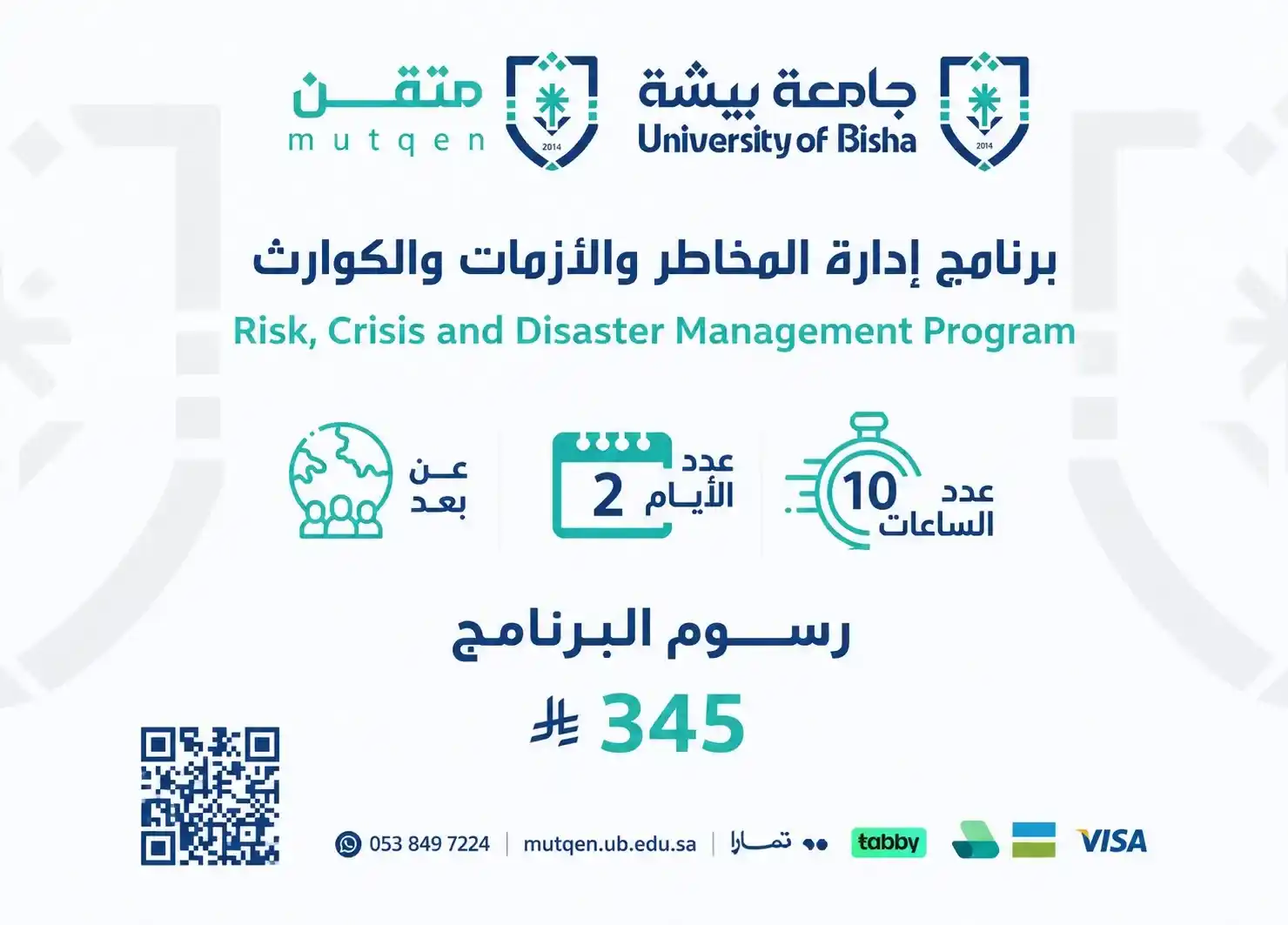
General Description
إليك ترجمة احترافية لبرنامج إدارة المخاطر والأزمات والكوارث، مع استخدام المصطلحات الدولية المعتمدة في معايير الجودة والاستمرارية (مثل ISO 31000 وISO 22301):
Introduction
In a world filled with challenges and uncertainty, the management of risks, crises, and disasters has become a strategic necessity to ensure business continuity and protect lives and property. Organizations that establish clear plans for emergency events are better equipped to face crises and mitigate their negative impacts. This program aims to provide participants with the knowledge and practical tools to identify and analyze risks, and to develop effective response plans for crises and disasters.
General Objective
To develop participants' skills in the field of Risk, Crisis, and Disaster Management, enabling them to design and implement effective response plans that ensure proper handling of emergency events and minimize potential losses.
Detailed Learning Objectives
By the end of this program, the participant will be able to:
-
Understand the fundamental concepts of risks, crises, and disasters and distinguish between them.
-
Identify types of risks and their sources within work environments and society.
-
Utilize risk analysis tools to prioritize mitigation and response efforts.
-
Formulate response and management plans for crises and disasters.
-
Lead and organize task forces during emergency situations.
-
Evaluate performance post-crisis and develop future improvement plans.
Training Modules
Day 1: Risk Management
-
Introduction to Risk Management:
-
Definition of risk and its importance in work environments and society.
-
Objectives of risk management and its role in Business Continuity (BC).
-
The difference between Risk, Threat, and Opportunity.
-
-
Risk Types and Sources:
-
Natural Risks (Environmental disasters, climate change).
-
Human-induced Risks (Human error, sabotage).
-
Operational Risks (Equipment failure, production issues).
-
Financial and Technological Risks.
-
-
Risk Analysis Methodologies and Tools:
-
Probability and Impact Matrix.
-
SWOT Analysis (Strengths, Weaknesses, Opportunities, Threats).
-
Root Cause Analysis (RCA) for problem-solving.
-
-
Risk Management Strategies:
-
Avoidance strategies.
-
Mitigation or Reduction strategies.
-
Transfer or Sharing strategies.
-
Acceptance strategies with contingency plans.
-
Day 2: Crisis and Disaster Management
-
Introduction to Crisis and Disaster Management:
-
Defining Crisis vs. Disaster and their distinction from Risk.
-
Characteristics and causes of crises.
-
The impact of crises and disasters on individuals and organizations.
-
-
Stages of Crisis Management:
-
Prevention and Preparedness stage.
-
Immediate Response stage.
-
Recovery and Reconstruction stage.
-
Learning and Continuous Improvement stage.
-
-
Emergency Planning and Business Continuity:
-
Steps to prepare an effective Emergency Plan.
-
Crisis Management Team (CMT) structure and roles.
-
Resource allocation during a crisis.
-
-
Communication Skills and Media Management:
-
Handling the media during a crisis.
-
Assurance messaging and building public trust.
-
Protecting organizational reputation during critical events.
-
Program Features
-
Training content based on the latest international standards and best practices.
-
Integration of theoretical knowledge with practical applications and interactive activities.
-
Real-world examples and case studies from local and global work environments.
-
Provision of practical training materials and ready-to-use tools.
-
Flexibility in adapting the program to suit the specific nature of the organization.
Program Outcomes
-
Ability to systematically identify and analyze risks.
-
Proficiency in preparing comprehensive crisis and disaster management plans.
-
Enhanced leadership and coordination capabilities during critical situations.
-
Strengthening the culture of institutional preparedness for emergencies.
-
Improved organizational response times and reduction of material and human losses.