General Description
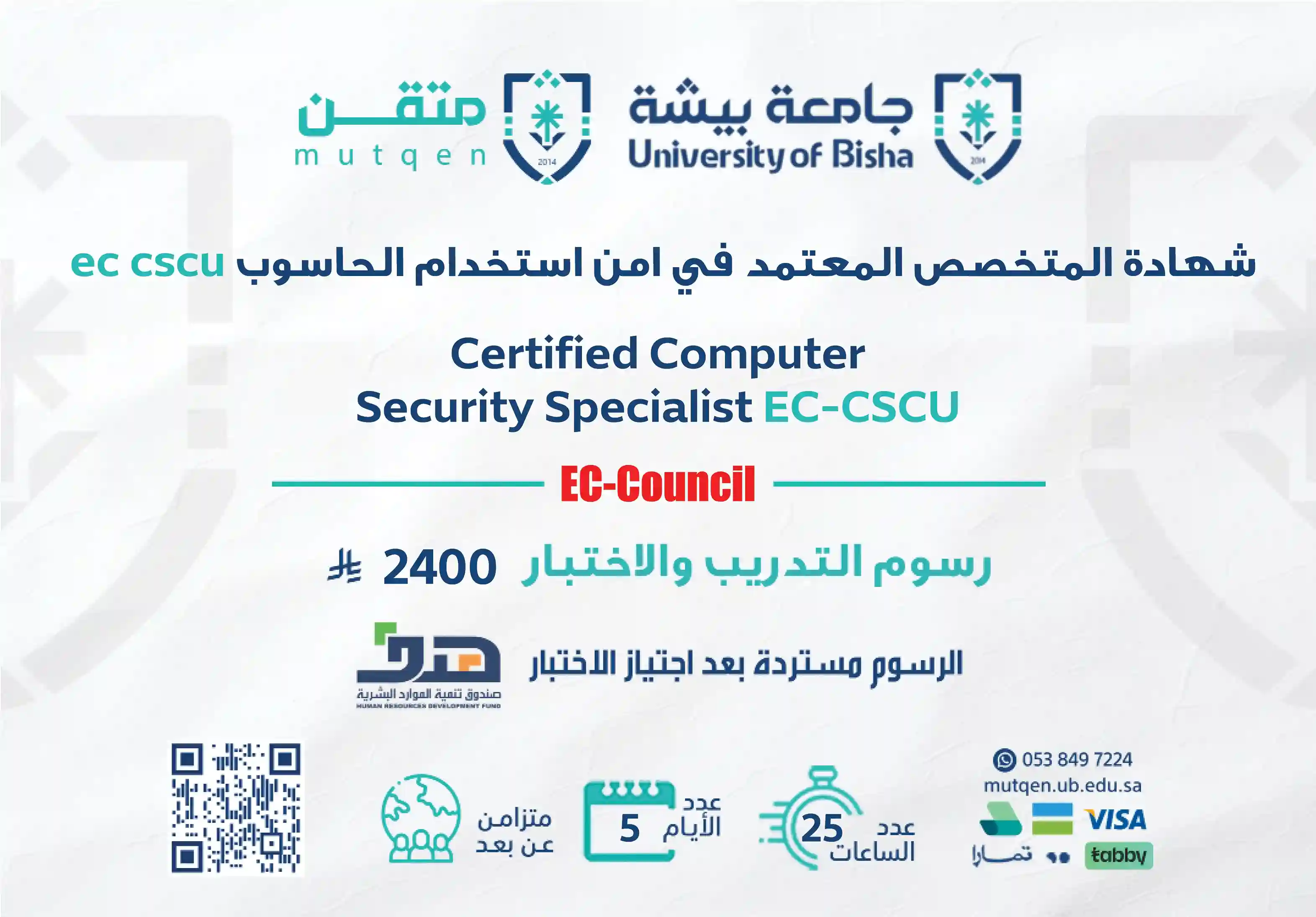
Get the EC-Council Certified Secure Computer User (CSCU) Certification now for only 2,400 SAR.. Book your spot today!
If you are seriously seeking to enhance your technical awareness and wish to secure your devices and accounts according to the best international standards, the Certified Secure Computer User (CSCU) certification in the Kingdom of Saudi Arabia is your ideal choice. This is an international professional certification issued by the global EC-Council organization, providing you with the ability to acquire essential skills and practical experience in cybersecurity fields, such as password protection, securing operating systems, countering malware, and ensuring the security of digital communications and networks.
Through this specialized program, the Motqen Platform for Open Education, affiliated with the University of Bisha, prepares you to master methods for confronting social engineering and electronic fraud attempts. This increases your professional value as a technically conscious individual capable of protecting sensitive data in the Land of the Two Holy Mosques.
Invest in your digital security now and join the elite specialists via the Motqen Platform for Open Learning to ensure a safe and stable work environment.
The Goals
The Certified Secure Computer User (CSCU) certification is one of the most prominent global credentials issued by the prestigious EC-Council organization. It aims to establish a strong security culture among individuals in the Kingdom of Saudi Arabia by focusing on practical application and enhancing behavioral awareness to reduce attacks targeting the human element. The program is delivered as intensive training spanning 5 days, with a total of 25 training hours via the Motqen Platform for Open Learning, providing participants with a real opportunity to build stronger digital awareness and develop their professional path with greater confidence.
Start your journey toward digital awareness and professional excellence today with the Certified Secure Computer User certification. Register now via the Mutqen Platform for Professional Certifications to reserve your place among the most prepared talents in the labor market.
Objectives of the EC-Council Certified Secure Computer User (CSCU) Certification
The Certified Secure Computer User (CSCU) certification aims to provide the trainee with a theoretical and practical foundation that helps them protect their data and accounts and deal more consciously with increasing digital risks. Through the Mutqen Platform for Accredited Certificates, trainees acquire applied skills that enhance their ability to use computers and digital communications more securely and confidently.
-
Empowering the trainee to protect their personal and institutional accounts and data from breaches within the Kingdom.
-
Understanding cybersecurity fundamentals and applying effective practices for password protection.
-
Securing operating systems, detecting malware, and preventing its risks.
-
Promoting secure use of email, home networks, and office networks in Saudi Arabia.
-
Developing the ability to confront social engineering attempts and electronic fraud methods with greater awareness.
Start your journey today with the Certified Secure Computer User certification. Register now via the Mutqen Platform for Accredited Certificates to build a powerful advantage for yourself in the world of digital security.
Target Auidence
Target Audience for the EC-Council Certified Secure Computer User (CSCU) Certification The Certified Secure Computer User (EC-CSCU) certification targets everyone seeking to enhance their security awareness and acquire practical skills for safely handling digital threats in both the work environment and daily life. Through the Motqen E-Learning Platform, trainees receive training content that keeps pace with market needs in the Kingdom of Saudi Arabia.
Groups Served by the Certification:
-
Government and Private Sector Employees in the Kingdom of Saudi Arabia.
-
New Employees wishing to prove their security awareness from the start of their careers.
-
Students and Tech Enthusiasts seeking to enter the cybersecurity field.
-
Users who rely on the internet for daily payments and transactions.
-
Customer Service and Technical Support Staff who are most vulnerable to fraud attempts.
Start today with the Motqen E-Learning Platform and benefit from the programs of the Institute affiliated with the University of Bisha for Research and Consulting to build a digital awareness that enhances your professional presence and protects you with greater confidence.
The Features
Benefits of Obtaining the Certification This certification grants you professional and cognitive value that enhances your presence in the labor market and confirms your awareness of the importance of digital security and data protection within modern work environments. It also contributes to raising the level of trust employers have in you and supports your ability to securely handle digital transactions and services with greater confidence.
-
Grants you a strong competitive advantage in the labor market within the Kingdom.
-
Reflects your commitment to protecting organizational privacy and sensitive data.
-
Enhances your credibility with employers in the Kingdom of Saudi Arabia.
-
Increases your confidence in handling banking transactions and e-commerce.
-
Helps you build a more secure digital life, free from threats and instability.
Develop your professional standing today, and obtain the accreditation you deserve through the Motqen Digital Platform for Education. Start your journey toward a more secure and confident digital future.
Topics
EC-Council Certified Secure Computer User (CSCU) Certification Topics The Certified Secure Computer User (EC-CSCU) certification covers a range of essential topics that help the trainee understand digital protection methods and deal consciously with electronic risks in both work environments and daily life. This specialized content provides a practical foundation that supports building stronger security awareness within the Kingdom of Saudi Arabia.
-
Identifying Malware detection methods and prevention techniques.
-
Enhancing browser security, digital communications, and wireless networks.
-
Understanding encryption mechanisms for sensitive data and secure information storage methods.
-
Acquiring skills to confront social engineering and modern forms of digital fraud.
-
Learning incident response steps and the correct actions to take when exposed to a breach.
Start now with the Motqen Educational Platform and gain practical knowledge that enhances your digital awareness and gives you stronger readiness to face electronic threats.
Learning outcomes
EC-CSCU Certification Learning Outcomes
The Certified Secure Computer User (EC-CSCU) certification provides the trainee with a wealth of theoretical and practical knowledge that helps them handle digital risks in the work environment and daily life with greater awareness. It also contributes to building a strong foundation for understanding cybersecurity principles and applying basic protection practices with higher confidence.
-
Ability to identify the most prominent and common digital threats.
-
Acquiring practical awareness of device and data protection methods.
-
Improving secure interaction with the internet and email.
-
Understanding the fundamentals of protecting accounts, passwords, and networks.
-
Reducing the likelihood of falling victim to phishing and electronic fraud attacks.
-
Applying essential security practices in both work and daily life.
-
Building a strong base to pursue broader learning in the field of cybersecurity.
Start today via the Motqen E-Learning Platform, and make the EC-Council Certified Secure Computer User (CSCU) certification a practical step toward stronger digital awareness and a more prepared professional future.
Requirements And Conditions
Requirements for Obtaining the Certified Secure Computer User (CSCU) Certification
This certification is an ideal starting point for entering the world of cybersecurity. It does not require advanced technical experience; instead, it focuses on building a strong foundation in information protection and safe computer usage.
Key Requirements:
-
No prior experience in the field of cybersecurity is required.
-
Basic knowledge of computer and internet usage.
-
Familiarity with general technical concepts is preferred (Optional).
-
Commitment to attending the training program and completing its requirements.
-
Successfully passing the final exam.
Don’t miss the opportunity—start today with the Mutqin Platform for Professional Certifications and earn your EC-CSCU certificate to launch your cybersecurity career with confidence.
The Blog
Exam Details The EC-Council Certified Secure Computer User (CSCU)
exam is an internationally accredited test by EC-Council. It aims to measure the trainee's comprehension of fundamental cybersecurity concepts in a practical and professional manner. The exam focuses on objective questions and applied cases that simulate reality, enhancing the trainee's readiness to work in advanced digital environments within the Kingdom of Saudi Arabia.
-
An internationally accredited exam from EC-Council to measure security understanding.
-
Focuses on practical cases and objective questions related to real-world scenarios.
-
Grants successful candidates a global certificate recognized by major companies.
-
Supports professional growth and opens wider career horizons in the labor market.
Start today with the Motqen Platform for Open Learning, and make the EC-CSCU certification exam your gateway to a more powerful and confident professional future.
Tips for Applicants
Good preparation for the EC-CSCU certification exam helps raise confidence levels and improve performance during the test. By focusing on practical understanding and regular training, the trainee becomes more prepared to handle security questions and scenarios with higher efficiency.
-
Focus on applied aspects and realistic scenarios during your studies.
-
Understand home network protection methods and grasp social engineering concepts.
-
Take advantage of mock exams available via the Motqen Educational Platform.
-
Read questions carefully to understand the details of the security threat before choosing an answer.
Your professional future begins with a conscious decision; invest in your development today and obtain your certificate via the Motqen Platform for Open Knowledge to create real value for yourself in the service of the Land of the Two Holy Mosques.